Beyond the routine of meetings and emails lies the true foundation of our success: our people. This month, we’re stopping to get to know our very own Director of Training for a candid Q&A. From their humble beginnings to what keeps them motivated, you’ll see a new side of the person behind the training.
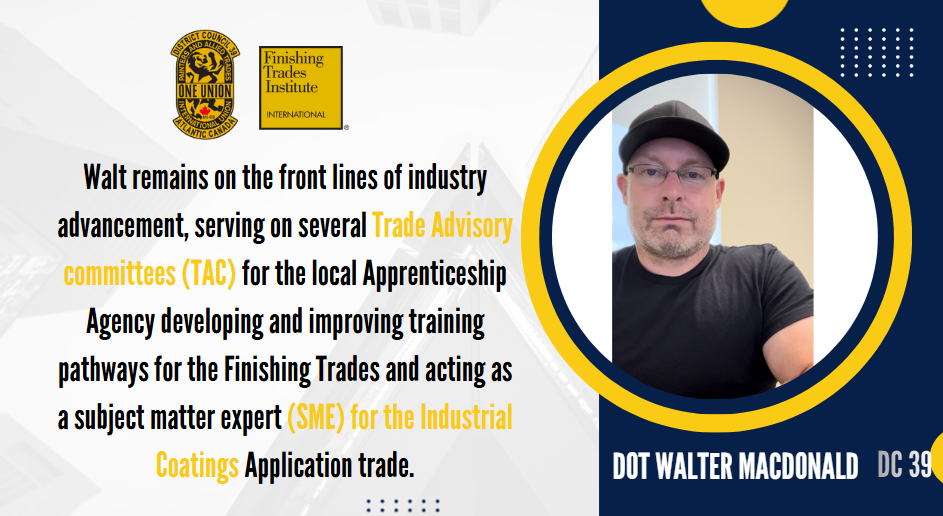
DOT Walter MacDonald, DC 39
Walt’s journey began in 1995 as an apprentice bridge painter. During the off-seasons, he pursued an education in computer programming and web-based application development. For many years, Walt balanced these dual passions, working in construction while running his own application development business. Walt continued with both careers until he became the Director of Training in 2010. A true lifelong learner, he has furthered his education to elevate his skills as both an instructor and a leader. In 2024, Walt was elected as the President of Local 1439 President and shortly after as the Vice President of District Council 39.
Today, he remains on the front lines of industry advancement, serving on several Trade Advisory committees (TAC) for the local Apprenticeship Agency developing and improving training pathways for the Finishing Trades and acting as a subject matter expert (SME) for the Industrial Coatings Application trade.
DOT Q & A
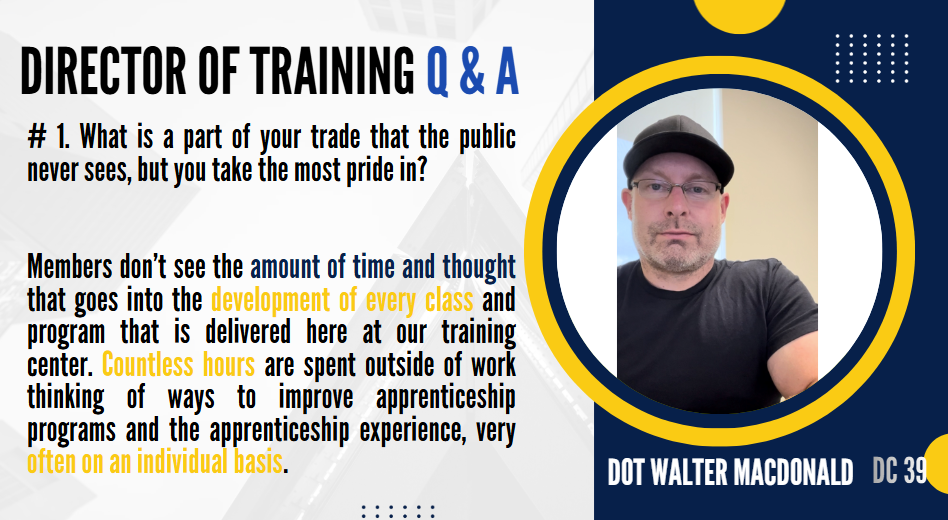
1. What is a part of your trade that the public never sees, but you take the most pride in?
Members don’t see the amount of time and thought that goes into the development of every class and program that is delivered here at our training center. Countless hours are spent outside of work thinking of ways to improve apprenticeship programs and the
apprenticeship experience, very often on an individual basis. I am very proud of the quality of programs we offer here, and the quality in which the capable instructors offer them.
2. What did you learn as a DOT?
I’ve learned so many things as a DoT. I’ve learned that consistency is crucial both in program delivery and when dealing with apprentices, consistency is the foundation of trust. I’ve learned to ask for help if I need it, to delegate more, I have a great team around me with a lot of experience to draw from, (I’m still learning this one). I’ve learned to keep a growth mindset, without that mindset, a training center will only ever serve basic industry needs, a growth mindset ensures that our training programs are innovative and create new opportunities for our apprentices to grow. We want them to thrive and become successful in their respective trade.
3. How has the trade/IUPAT changed you as a person?
In this role you deal with a lot of personality types, people of varying backgrounds and life experiences. In life I’m usually quick to make a decision due to the volume of decisions that need to be made, but through the years of dealing with so many apprentices and journeypersons, I’ve learned that I need to listen more in order to help them effectively. The One Union, One Family, One Fight motto has reminded me that as a Union member, we are all together, we fight the same battles and share the same goals, it’s easier to accomplish beneficial tasks when you know that you are surrounded by like minded people with similar goals.
4. What is your best advice to an apprentice?
Stick with it, stay through the tough times, it will pay off. Ask any Journeyperson. Completing your apprenticeship gives you a sense of accomplishment that sets the pace for whatever comes next in your life.
5. What is the best piece of advice you received as a DOT?
From my BM/ST, make a decision and stick to it, base your decisions off solid experiences to ensure consistency. You’ll save a lot of time and frustration from having to re-make and re-think your decisions.
6. When people hear your name ten years from now, how do you want to be remembered?
I want people to remember me as a DoT that took the time to build the foundation for our apprenticeship programs to be successful, programs that are reinforced by strong relationships with our apprentices, journeypersons, industry partners, and signatory contractors.
published in the iFTI September newsletter
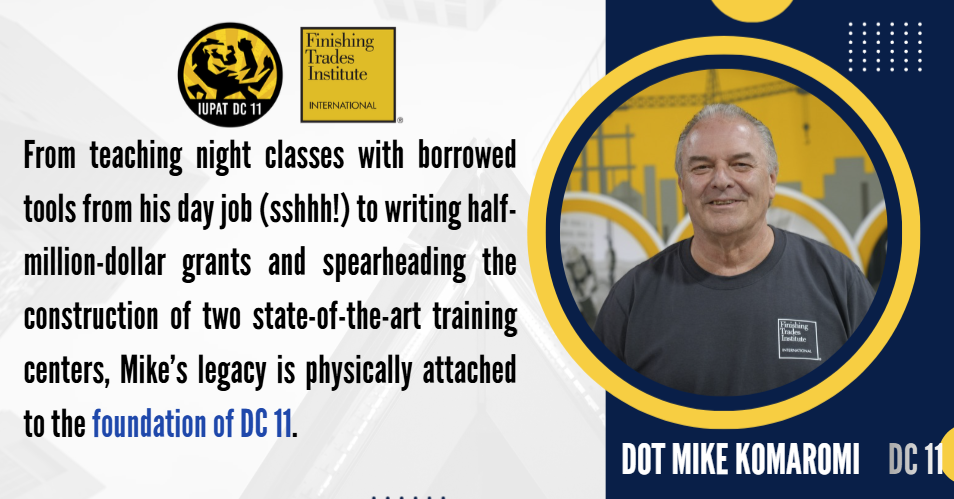
DOT Mike Komaromi, DC 11
Prior to DOT Komaromi’s retirement last July 1st, we sat down with Mike to capture his parting words of wisdom and looked back at his remarkable 46-year journey.
Six months after walking across the stage at his high school graduation in 1980, Mike Komaromi started working at a local glass shop in Connecticut, learning the trade from four seasoned journeymen who guided, pushed, and inspired him to become a true master of the trade. By 2006, Mike stepped into the role of Director of Training (DOT) – fueled by a relentless passion for teaching and elevating the crafts. From teaching night classes with borrowed tools from his day job (sshhh!) to writing half-million-dollar grants and spearheading the construction of two state-of-the-art training centers, Mike’s legacy is physically attached to the foundation of DC 11.
DOT Q & A
1. What is a part of your trade that the public never sees, but you take the most pride in?
Dedication that is required to be a DOT. Nobody knows what it takes and what’s involved. The business end of the job no one sees. DOTs are running a business. Loved teaching apprentices but didn’t know the business end of the job. The most rewarding part is to hear “thank you” from an apprentice that their time, training and work in the union was made possible by Mike’s support and they are appreciative
2. What did you learn as a DOT?
The importance of taking advice from other DOTs and instructors; every council does something better than the next and there is so much to learn from others in our industry/ in our field; hearing the suggestions and opinions from others is important; a time when you have to deal with the same situation. Telling members the truth about themselves that others wouldn’t say for their own benefit – I didn’t tiptoe around issues; sometimes things were going on for years; I had the member “come to Jesus moment” blaming the union and reps for everything but when he sat down with me I made him realize it wasn’t the union; take an introspective look at that members behavior; not afraid to tell the truth; everyone else’s fault but his; but after the meeting he was thankful that I told the truth; he (the member) has shared that information with others; truthfulness helped him turn around. Difficult dealing with members but it is best to tell them the truth.
New Haven Director of Training award – ability to change lives!!!!!
3. How has the trade/IUPAT changed you as a person?
IUPAT gave me discipline and developed pride in myself and what I do. The union taught me to share my knowledge with others; dedication and responsibility and to realize that this is much bigger than just myself and how important it is to pass on my knowledge and expertise and keep learning continuously for myself and apprentices.
4. What is your best advice to an apprentice?
Learn all you can. Stick with it. Be there everyday and on time and to get involved in as many Union activities as you can; I was always involved as trustee, contract negotiation teams, Christmas party planner/publicize; attended union meetings ; still a delegate to our union. A first impression is a lasting impression so make sure it is a good impression!
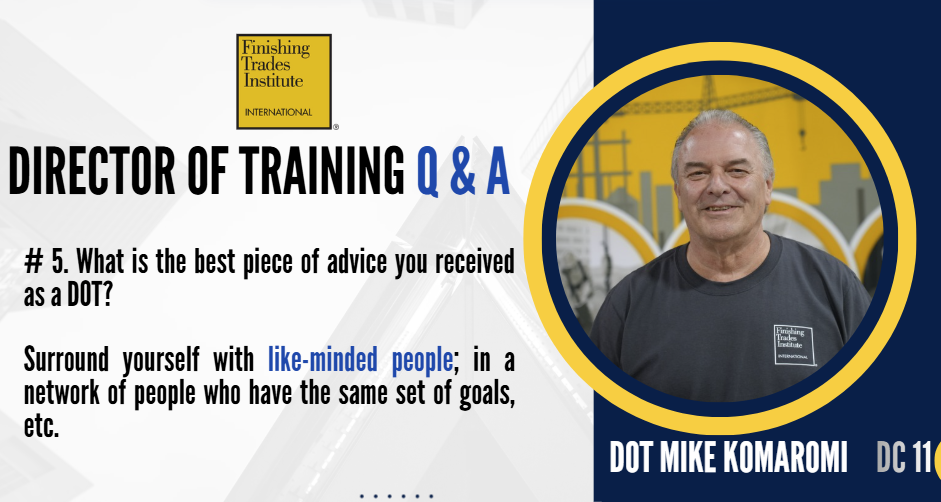
5. What is the best piece of advice you received as a DOT?
Surround yourself with like-minded people; in a network of people who have the same set of goals, etc.
6. When people hear your name ten years from now, how do you want to be remembered?
Mike who? I want to be remembered for the planning and erection of the training centers (Middletown, CT and Rhode Island) – project manager; designed the centers to be functional and welcoming; I arrived with a book, glass cutters, had to bring every tool from work to the training center to teach the apprentices (sshhh the contractor doesn’t know) Grants to uphold (a $600 grant from CPWR was his first grant award – still has the photo of the check in his office) Up to $500,000 today; never thought I’d be able to write grants that effectively supports our union and training.
7. What will you miss the most about being in the training center daily?
My staff. Very supportive of me and dedicated; I worked hard and long to develop a staff with in and outs with instructors and have a great staff; Angel is a great successor and I couldn’t be more proud of him; Angel was his interview years ago and he has grown and matured into being my successor; I know they are in good hands.
published in the iFTI July newsletter
DOT Eric Redding, DC 35
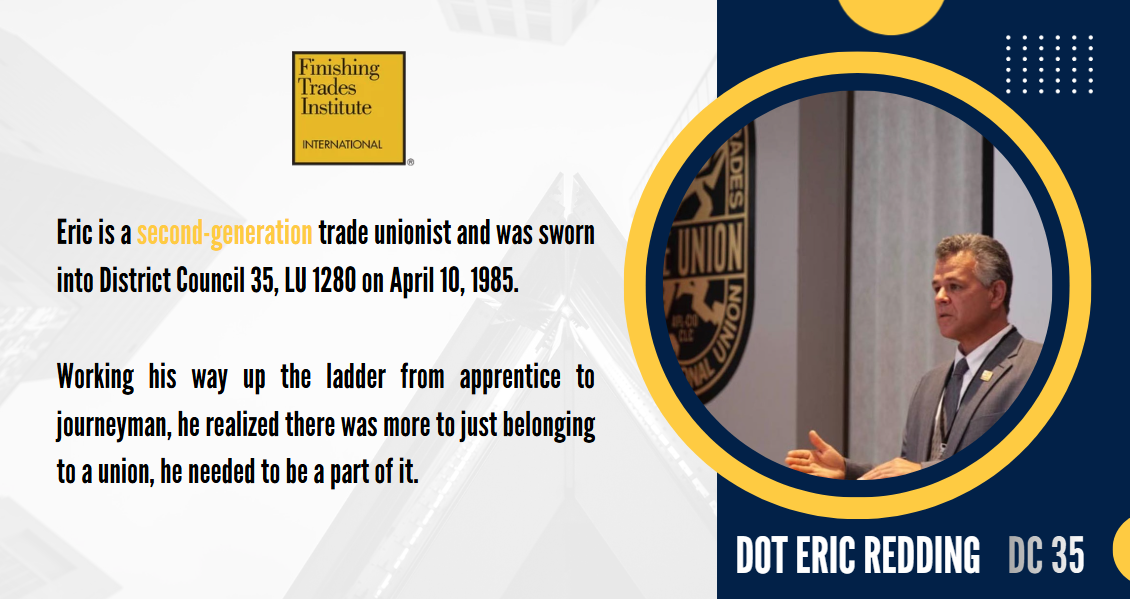
After the recession of the late 1980s, Eric set out to make his mark in the industry, first getting elected as Recording Secretary of his Local and second, being named a foreman to the expansion project of the South Shore Plaza in Braintree Massachusetts. Soon after, he took the role of Part-time instructor at the unions training center, that lead to a full-time position in 1999 and then Director of the program by 2004.
Eric is responsible for the training of up to 4000 members across the four northern New England states. Upon accepting the position, he was tasked with building an additional training center and in the summer of 2005 a new state of the art facility was opened in Brentwood NH.
With a lifelong passion to help others, he was named as part of a unique group inside DC 35 to bring the current registered apprenticeship programs to the U.S. Department of Labor and become an accredited college.
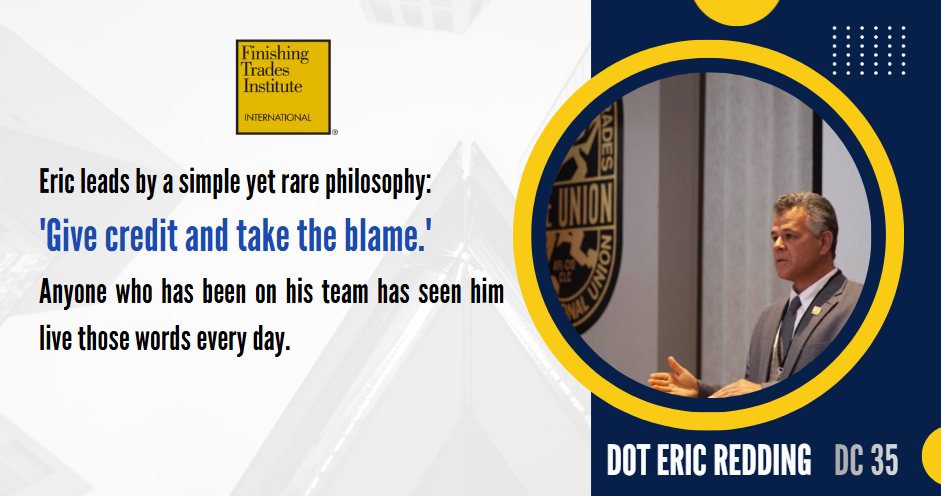
In December of 2017 the FTI of New England became the first Registered Apprenticeship program in the New England Area to become accredited by the U.S Department of Education, thus forever changing the lives of many. If you’ve had the chance to work with Eric most likely you’ve heard him say “my job is to give credit and take the blame”, He believes in the team approach and always works to elevate them.
DOT Q & A
1. What is a part of your trade that the public never sees, but you take the most pride in?
This might sound crazy, but I take pride in the fact that when the job gets hard, I dig in and I don’t want to disappoint. The public will never know the hours we spend in the office getting things done.
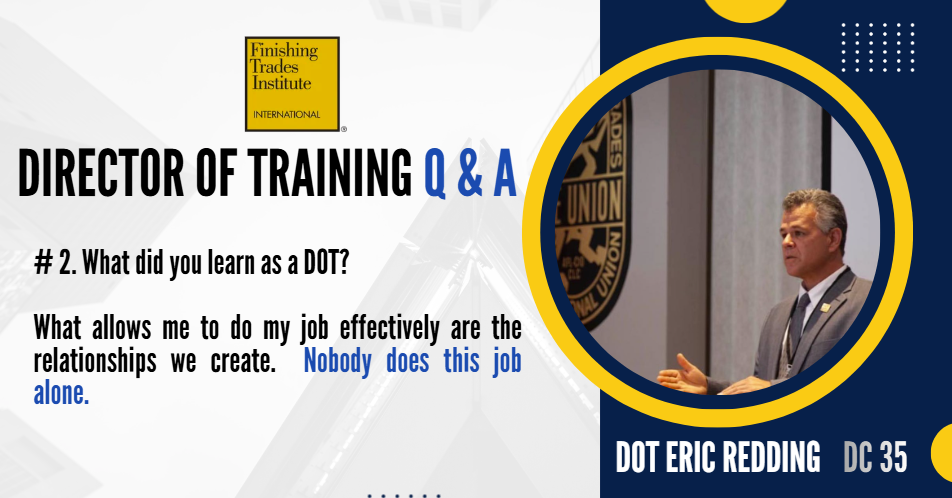
2. What did you learn as an instructor?
What allows me to do my job effectively are the relationships we create. Nobody does this job alone.
3. How has the trade/IUPAT changed you as a person?
When I joined this union, I was a kid, I thought I knew everything, I didn’t but I wasn’t afraid of hard work. I grew as a person; the IUPAT & labor movement allowed me to become the person I was supposed to be.
4. What is your best advice to an apprentice?
The hardest part of your career is the beginning; nobody knows you and everything is new. Don’t get disappointed because you can’t do something yet. Get focused and keep moving forward.
5. What is the best piece of advice you received as a DOT?
Stay in your lane
6. When people hear your name ten years from now, how do you want to be remembered?
That I was part of a team that never stopped trying to better the lives of our members, that we did our part to make the labor movement a better place for all workers.
published in the iFTI May newsletter
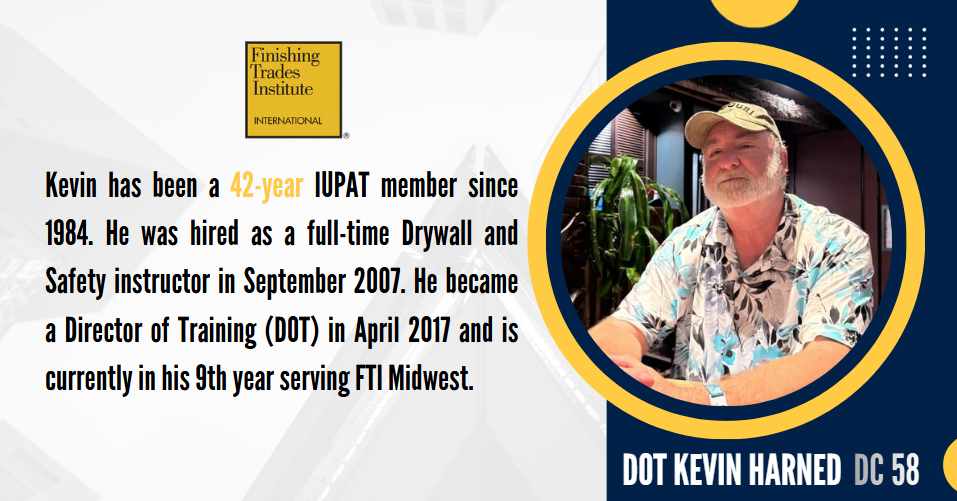
DOT Kevin Harned, DC 58
DOT Q & A
1. What is a part of your trade that the public never sees, but you take the most pride in?
I am committed to providing opportunities for our members, and ensuring members return home safely to the families who depend on them.
2. What did you learn as an instructor?
Looking back on over two decades in the field, I survived the field on a mix of luck and telling myself “it would be alright”. I placed myself in harm’s way more times than I can count – often without realizing it. Normalization of Deviance is the number one unseen enemy, not just on the job site, but in every aspect of our lives.
Every time I bypass best practices, it establishes a deviant norm that will eventually be tested in the future. We see it in the way we drive, the way we eat, and the way we show up in our relationships—we keep pushing the boundary until the boundary finally breaks.
My goal is to replace that ‘it won’t happen to me’ mindset with the technical mastery and awareness I wish I’d had back then.”
3. How has the trade changed you as a person?
Out of urgent need, I quit high school halfway through my senior year to begin working as a non-union Drywall Finisher and Painter. When I was 19, I was offered an opportunity to work for an IUPAT signatory shop, took it, and have been a member since. This enabled me to purchase my first home at 21 and provide a living, insurance, and pension for my family.
At 30 years old, I took my GED because not having my diploma always bothered me. Some coworkers asked me ‘Why bother?’ They argued that it wouldn’t add a dime to my paycheck as a painter. I told them simply: ‘It’s just something I need to do for myself.’ More than a decade later, my diploma was an essential credential that allowed me to be hired as an IUPAT instructor and step into the role of Director of Training.
4. What is your best advice to an apprentice?
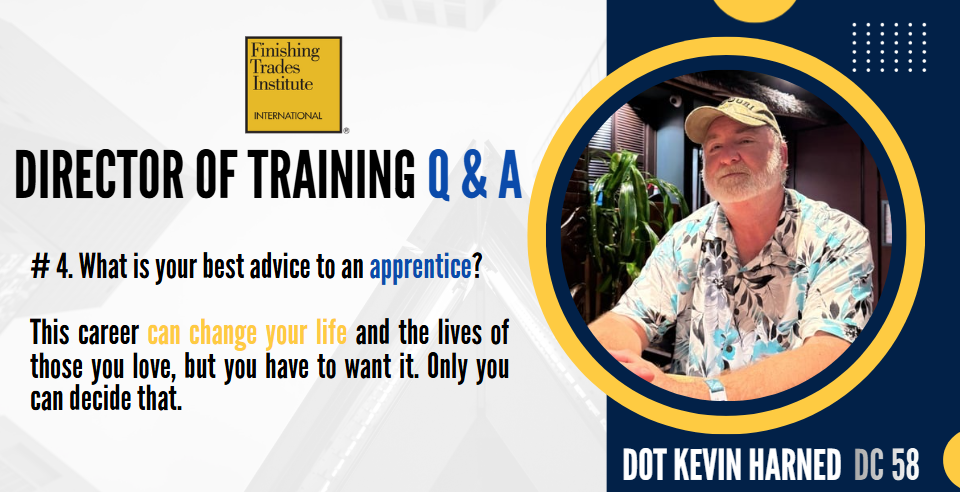
This career can change your life and the lives of those you love, but you have to want it. Only you can decide that.
The best job security you can have is to have the foremen ask for you by name. Be teachable, nobody will fight you to teach you. Be dependable, be on time, and stay off your phone and yes texting is on your phone. If you do not understand what you’re asked to do, ask questions. Do those things and you will have a long career.
5. What is the best piece of advice you received as a DOT?
This is not an hourly job. If you go into it believing that it is, you will be greatly disappointed.
6. When people hear your name ten years from now, how do you want to be remembered?
My goal is to make an impact on the lives of our members. I’m here to make a lasting difference, not just to check boxes or collect a paycheck.
published in the iFTI April newsletter